
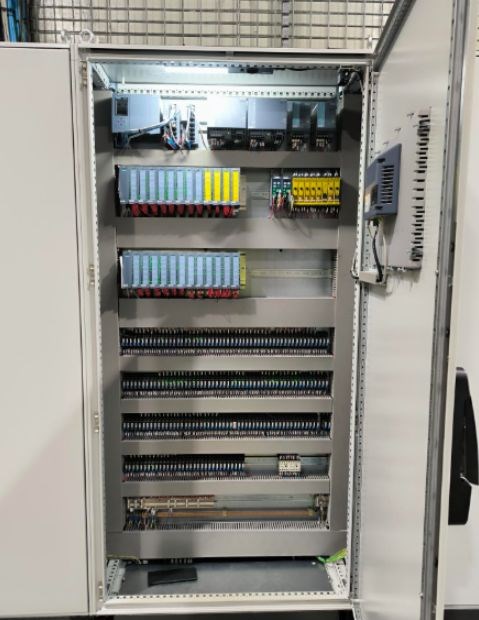
We design, program and commission safety instrumented systems (SIS), and verify to IEC 61511 that each safety function can achieve its required SIL.
A SIS brings the process to a safe state when a variable goes beyond its limits, independently of the basic process control. Designing it together with the control system makes operation, diagnostics and maintenance easier, without mixing safety functions with control functions.
What we do
SIS engineering
Logic solver architecture, safety signal allocation, isolators, relays and complete system documentation.
Safety programming
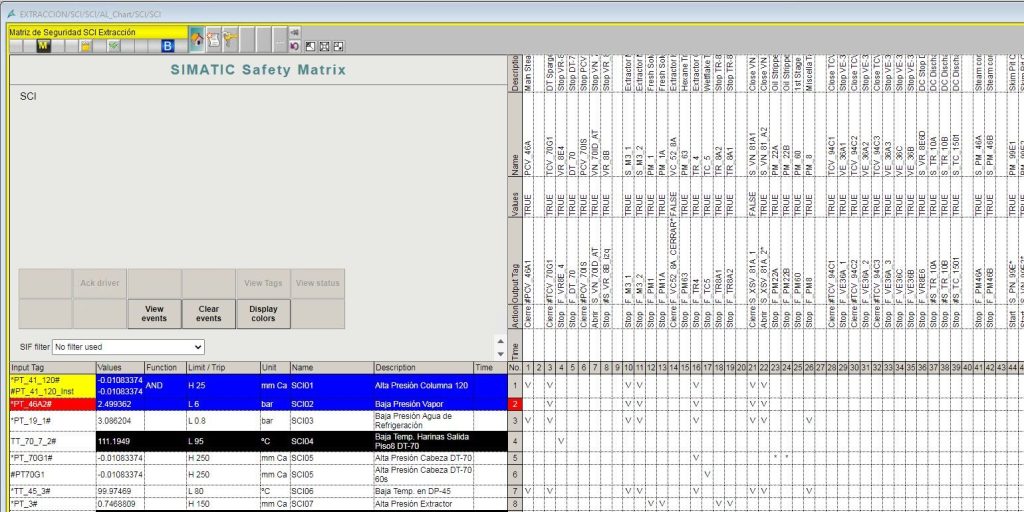
Safety logic with SIMATIC S7 F Systems and cause-and-effect matrices with SIMATIC Safety Matrix, integrated in Siemens PCS 7.
SIL verification
Calculation and verification of each safety instrumented function (SIF) to IEC 61511, with IEC 61508 criteria.
Supply and commissioning
Safety PLC and cabinets, installation, on-site commissioning and training.
SIL verification, step by step
SIL verification checks on the design that each SIF can achieve its required integrity level. We follow IEC 61511, with IEC 61508 and VDI/VDE 2180-4 criteria:
- 01
Input data
Safety requirements specification (SRS), functions with their required SIL, voting of sensors and final elements, architectures and reliability data.
- 02
Architecture of each SIF
Sensors, logic solver and final elements, with their architectural constraints and hardware fault tolerance (HFT).
- 03
PFD calculation
Probability of failure on demand with reliability block diagrams, per channel, subsystem and function, including proof tests and common cause failures.
- 04
Achievable SIL
Comparison of the SIL each function achieves with the SIL it requires.
Verification is not validation: SIL verification is carried out on the design, and validation checks the installed SIS against its specification.
Integration with Siemens PCS 7
In Siemens PCS 7 we develop the safety logic with S7 F Systems and configure cause-and-effect relationships with Safety Matrix, so that the operator can see from the operator station which cause triggered each action. Safety can coexist with redundant controllers: redundancy improves control availability, while the integrity level of each function is set by its design and its SIL verification.
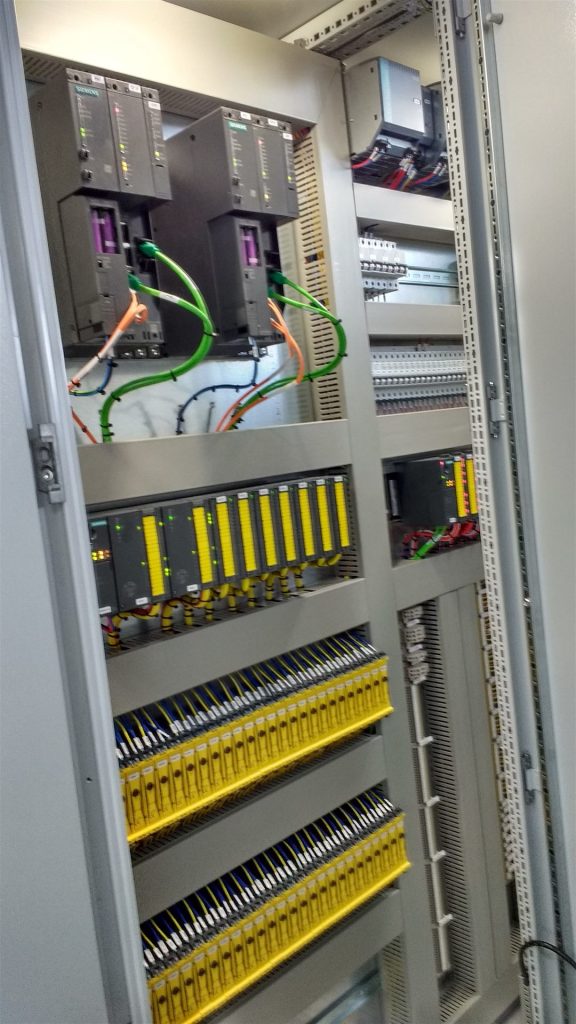
Featured reference · Ras Laffan (Qatar)
SIS SIS engineering and SIL verification for Dolphin Energy
For Dolphin Energy’s KHI removal unit, MIESA designed the safety instrumented system, supplied and programmed the safety PLC, verified the SIL of its functions and commissioned the system, integrated with Siemens PCS 7 and redundant CPU 410-5H controllers.
- SIL verification · IEC 61511
- Safety PLC
- S7 F Systems
- Safety Matrix
- Redundant CPU 410-5H
- HPD–Veolia · 2016–2018
Frequently asked questions
What is SIL?
The safety integrity level (SIL) expresses the risk reduction that a safety instrumented function must provide. IEC 61511 defines four levels, SIL 1 to SIL 4; in the process industry SIL 1 to SIL 3 are the usual ones.
What is the difference between verification and validation of a SIS?
SIL verification checks at the design stage that the architecture and reliability data of each function allow the required SIL to be achieved. Validation is carried out on the installed SIS and checks that it meets its safety requirements specification.
Can the SIS be integrated into Siemens PCS 7?
Yes. With S7 F Systems the safety logic runs in Siemens controllers with fail-safe modules, and Safety Matrix allows cause-and-effect matrices to be configured and displayed from PCS 7 itself.
What information do you need for SIL verification?
The safety requirements specification (SRS), the list of functions with their required SIL, the voting of sensors and final elements, the planned architectures and the reliability data of the components.
Do you need functional safety engineering?
If your plant needs a safety instrumented system or SIL verification of its functions, tell us about your project.