
- SISengineering, safety PLC and SIL verification to IEC 61511
- 1,500I/O signals across the whole project
- 410-5Hredundant Siemens controllers (S7-400H)
- V8.1Siemens PCS 7 with Safety Matrix
KHI removal and distillate recovery
Unit 110 of the Ras Laffan water treatment plant (Qatar) treats wastewater containing kinetic hydrate inhibitors (KHI) from Dolphin Energy’s gas facilities. By evaporation, it separates a KHI-free distillate, which is recovered, and a concentrated stream that is handled separately.
Between 2016 and 2018, within HPD Process Engineering’s (Veolia group) industrial water management project, MIESA was responsible for the automation of the unit and its safety instrumented system (SIS):
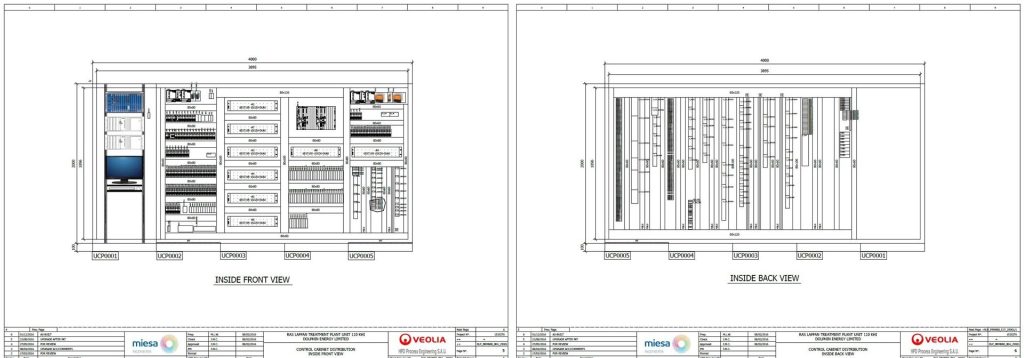
- Basic and detailed electrical hardware engineering
- Basic and detailed software engineering
- Integrated automation at levels 0, 1 and 2
- SIS design and engineering and SIL verification
- Supply of the control equipment, the safety PLC and the control desks
- Low-voltage electrical installation and instrumentation installation
- On-site commissioning and training
Field sensors, final elements and the final validation of the SIS were outside MIESA’s scope.
Safety instrumented system
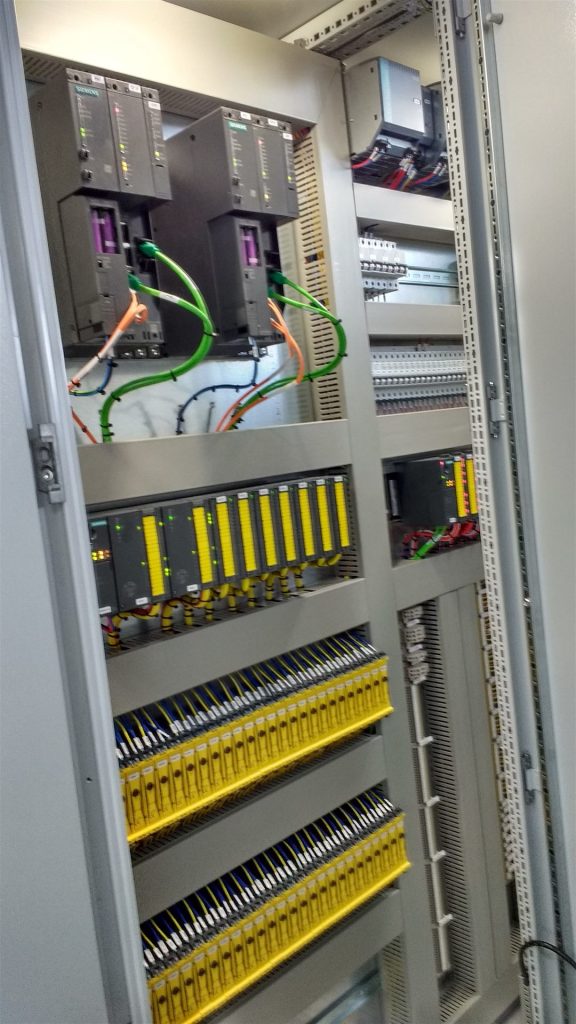
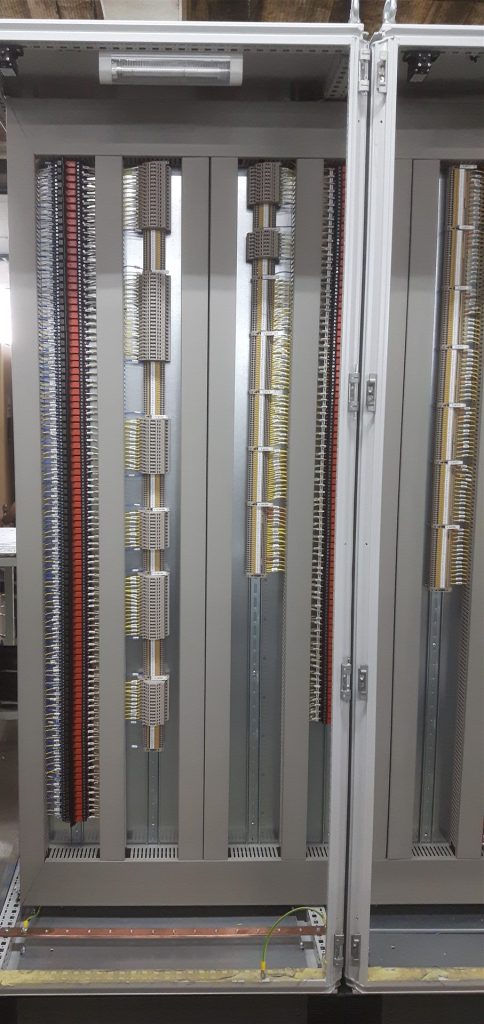
The SIS brings the unit to a safe state when the process goes beyond its limits, independently of the basic process control. MIESA designed its engineering, supplied the safety PLC, programmed, installed and commissioned it. The hardware includes digital and analogue safety inputs and outputs, signal isolators and relays.
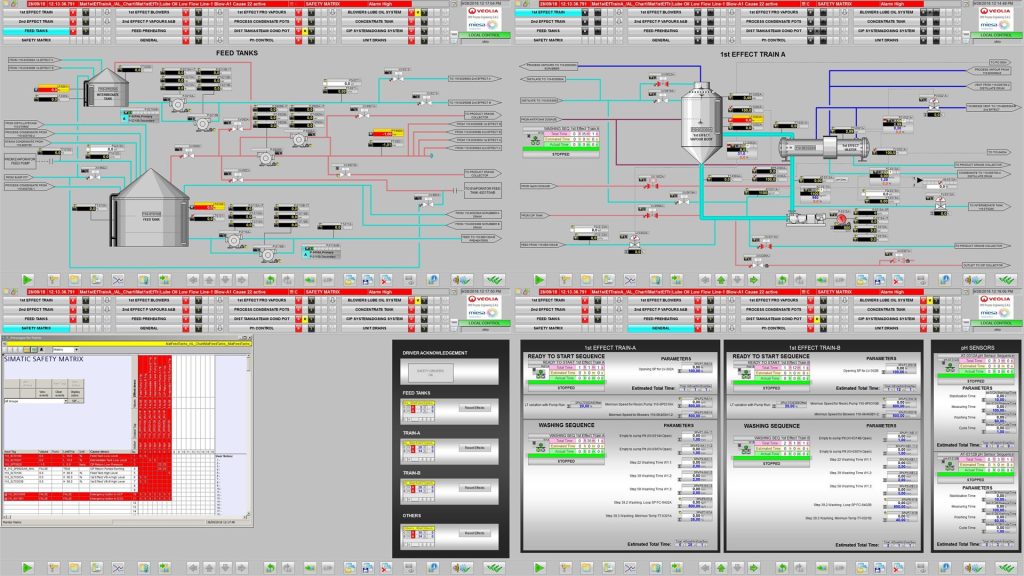
The safety logic was developed with SIMATIC S7 F Systems, integrated in the PCS 7 environment. Cause-and-effect relationships were configured with SIMATIC Safety Matrix: Safety Matrix Tool on the engineering station to define them and Safety Matrix Viewer on the operator station, so that the operator can see which cause triggered each action. Process sequences are followed with PCS 7 SFC Visualization.
SIL verification to IEC 61511
SIL verification checks that the design of each safety instrumented function (SIF) can achieve its required integrity level. MIESA approached it according to IEC 61511, with IEC 61508 and VDI/VDE 2180-4 criteria, based on the safety requirements specification (SRS), the list of functions with their required SIL, the voting of sensors and final elements, the architecture documentation and the reliability data of the components. The method covers:
- Identification of each SIF and its architecture: sensors, logic solver and final elements
- Architectural constraints and hardware fault tolerance (HFT)
- Calculation of the probability of failure on demand (PFD) with reliability block diagrams, per channel, per subsystem and for the whole function
- Proof test intervals and common cause failures in redundant configurations
- Comparison of the achievable SIL of each function with the required SIL
This verification belongs to the design phase and is distinct from the validation of the installed SIS.
Control with Siemens PCS 7 and redundant controllers
The control system is Siemens SIMATIC PCS 7 V8.1 SP1, with CPU 410-5H controllers of the S7-400H family in a redundant configuration and eight ET 200M remote I/O stations with standard and fail-safe modules (F-DI, F-DO and F-AI). It is completed by an engineering station, a standalone operator station (OS Single Station) and an engineering and maintenance laptop.
Controller redundancy improves the availability of the control system; the integrity level of each safety function, however, depends on its design and its SIL verification.
Communications, installation and commissioning
The control system communicates over Modbus TCP with the Bently Nevada equipment through the communication processors of the controller racks, with a redundant connection (redundant Modbus TCP and S7 REDCONNECT).
MIESA also carried out the low-voltage electrical and instrumentation installation, commissioned the system in Ras Laffan and provided the training.
Do you need SIS engineering or PCS 7 automation?
If your plant needs a safety instrumented system, SIL verification of its functions or a Siemens PCS 7 control system, tell us about your project.